Sound Insulation Inspection for Walls and Facades: Ensuring Performance and Engineering Quality in Large-Scale Projects
 Inspectex Team
كل المقالات
2026-03-31
The urban boom and elevated living standards in Saudi Arabia necessitate strict inspection protocols to ensure the efficiency of modern buildings. Sound insulation has become a cornerstone of sustainability and luxury, moving beyond its traditional view as a secondary element. Consequently, field-based real estate inspection emerges as a pivotal engineering tool to verify that facades and structural partitions possess the actual capacity to prevent noise ingress. Relying solely on design blueprints may not accurately reflect the final results achieved after field execution. These measurements protect developers and investors from operational risks and legal liabilities associated with the quality of the acoustic environment within a facility.
Inspectex focuses on adapting advanced engineering solutions for the business sector by providing a reliable technical reference based on objective field measurements. This guide highlights the professional path for evaluating sound insulation in walls and facades and how vibrations and frequencies are translated into precise analytical reports. This process ensures project compliance with international codes, helping developers and investors avoid technical deviations or legal claims after final delivery.
Why Sound Insulation Matters in Modern Construction
The capital value of major real estate assets depends on their alignment with the privacy standards required by the end-user. Therefore, on-site sound insulation inspection is a vital technical procedure to document that execution matches approved contractual specifications. Based on field data, inspection helps bridge the gap between theoretical and actual performance, enhancing a developer’s reputation and ensuring high occupancy rates in specialized projects.
The Impact of Noise on Asset Value and Operational Performance
Inadequate noise control between spaces leads to a decline in a project’s investment appeal, potentially resulting in increased legal and financial complaints after operation. Providing efficient sound insulation reduces corrective maintenance costs that may be imposed later due to disputes over acoustic privacy. Engineering auditing helps raise a building’s rating within international quality standards.
The Gap Between Design Specifications and On-Site Execution
Structural studies confirm that insulation materials reach maximum efficiency only through precise field detailing and sound structural bonding. Thus, sound insulation inspection aims to monitor any deficiencies resulting from poor execution or variations in the quality of materials supplied to the site compared to design specifications. On-site inspection provides consulting offices and contractors with a technical evidence tool that ensures project acceptance by accreditation bodies, facilitating smooth handover processes.
What Is Sound Insulation?
Before evaluating performance, it is necessary to establish a precise technical definition and understand what sound insulation actually controls in a built environment.
Defining Sound Insulation and Its Role in Building Performance
Sound insulation is the property of a building assembly wall, floor, ceiling, or facade that measures its ability to reduce the transmission of airborne sound between spaces. It is quantified by the reduction in decibels (dB) that an assembly provides across a defined frequency range. Higher values indicate better acoustic separation between adjacent spaces. Sound insulation is distinct from sound absorption; while absorption manages reverberation within a room, insulation controls the sound passing through the building envelope.
What Is Sound Insulation and What Is a Sound Insulator?
A sound insulator is any material or assembly component that contributes to reducing sound transmission. However, the acoustic performance of any assembly depends on the combined mass, decoupling, absorption, and airtightness of the complete system rather than any single material in isolation. Achieving practical “soundproofing” requires all performance mechanisms to function together.
Sound Insulation Testing Methodology
Inspectex follows international engineering standards in executing field tests to ensure results are reliable for technical and legal purposes.
Field Inspection Protocol: From Source Room to Receiving Room
Our field measurements assess the ability of partitions to reduce airborne sound transmission between source and receiving areas through the following steps:
- Defining the Measurement Scope: Our team accurately identifies the source and receiving spaces based on architectural drawings.
- Generating Standard Noise: We utilize an omnidirectional dodecahedron loudspeaker to ensure a uniform sound distribution that mimics operational reality.
- Measuring Sound Pressure Levels: Sound levels are monitored in the source room, followed by measuring the transmitted sound in the adjacent space using calibrated microphones.
- Analyzing Reverberation Time: We measure reverberation time when necessary to correct results based on the absorption characteristics of the space.
- Calculating Actual Insulation Values: Results are extracted according to internationally approved STC or Rw formulas.
All operations comply with ASTM E336 and ISO 16283 standards, ensuring precise detection of wall porosity.
Specialist Equipment Used for Accurate Acoustic Assessment
The accuracy of an inspection relies on high-sensitivity devices that convert sound waves into precise digital data. Inspectex utilizes the latest internationally certified equipment, including:
- Omnidirectional Dodecahedron Loudspeaker: Vital for generating a uniform sound field.
- Real-Time Analyzer: Dissects sound into different frequencies to identify insulation weaknesses at specific levels.
- Calibrated Microphones: Dedicated to monitoring the finest levels of sound leakage with laboratory precision in a field environment.
- Data Recording and Analysis Systems: Specialized software processes readings and extracts final insulation values based on approved physical laws.
Common Sound Insulation Defects in Buildings
Real acoustic challenges appear at the intersections of a building’s operational systems, where untreated areas represent potential “sound leaks”.
MEP Penetrations and Untreated Structural Gaps
Mechanical, electrical, and plumbing (MEP) penetrations are major factors leading to the failure of expertly designed insulation systems. Duct paths and distribution boxes often break the continuity of insulation material. During sound insulation inspection, Inspectex ensures that Wall Sound Insulation achieves a complete seal around these penetrations to prevent acoustic bridges. Furthermore, neglecting to seal structural joints sharply reduces overall insulation efficiency.
Material Density Variations and Inconsistent Supplier Delivery
The performance of wall and facade insulation is directly linked to material mass and the quality of layers used. Any change in block density or insulation component thickness will inevitably lead to a decline in insulation values during field testing. Specialized real estate inspection ensures that suppliers adhere to approved specifications, which is essential for ensuring building compliance with national requirements.
Applications of Sound Insulation Across Sectors
Technical auditing is increasingly important in projects requiring a controlled acoustic environment, where sound quality is integral to project identity.
Hospitality and Healthcare: Hotels and Hospitals
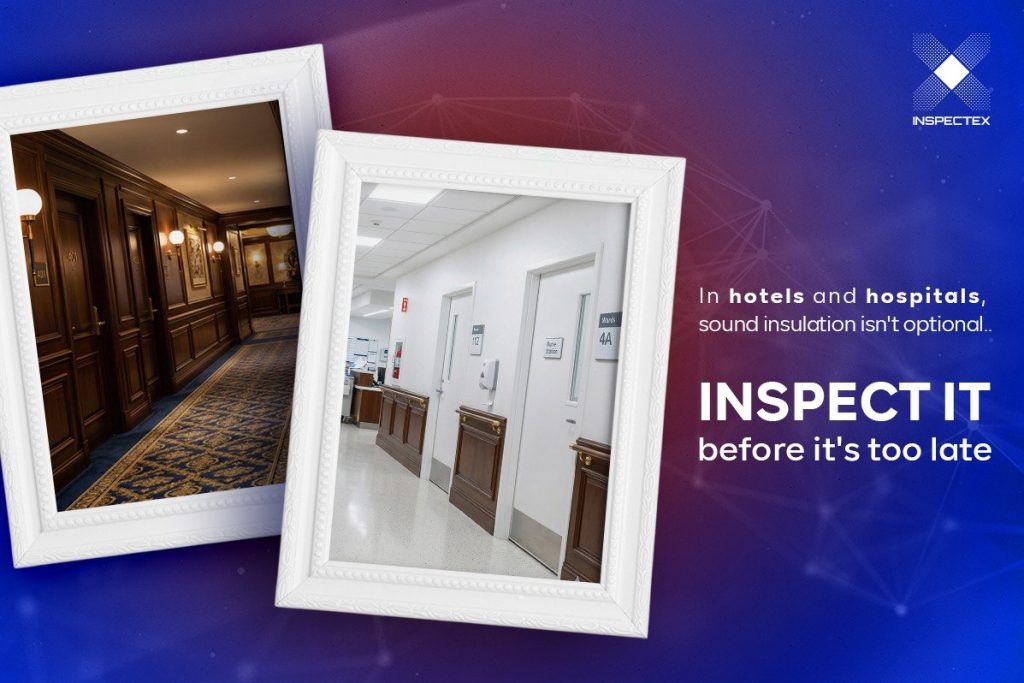
The competitiveness of hotels and resorts depends on providing maximum privacy for guests. Sound insulation inspection reports help avoid complaints regarding hallway noise. Similarly, hospitals and medical centers impose strict requirements to prevent sound transmission, ensuring patient confidentiality and psychological comfort.
Educational Facilities, Offices, and High-Traffic Facades
Theaters, performance halls, and schools require an acoustic environment that aids clarity and focus. This highlights the need for roof and facade sound insulation to block high-traffic noise. Field inspection ensures that the acoustic design achieves the building’s functional purpose, increasing productivity in modern administrative buildings and universities.
Risk Management and Legal Protection Through Testing
Proactive insulation auditing achieves immediate material and moral gains for developers and consultants.
Reducing Post-Occupancy Complaints and Legal Exposure
Many beneficiaries suffer from noise problems after moving in, leading to complex legal disputes and potentially expensive maintenance claims. The inspection step helps build a trusted relationship with clients and ensures their complete satisfaction.
Technical Documentation as a Legal and Commercial Asset
Inspection provides certified technical documentation that can be relied upon in disputes or future property valuations. This ensures that the financial value paid by the buyer matches the actual engineering performance of the building. Consequently, our inspection reports become a legal and technical protection tool that neutralizes risks and ends unscientific estimations in building quality assessment.
When Should Sound Insulation Testing Be Conducted?
The timing of the test is a decisive factor in determining the ease of remediation and the accuracy of results.
Pre-Handover: Before Final Finishes Are Installed
Performing a real estate inspection for sound immediately after field execution and before installing final decorations is the optimal time to ensure project compliance. At this stage, it is easier to monitor sound leakage resulting from service penetrations or poor joint treatment. This proactive approach allows developers and contractors to clear their technical responsibility and provide units free of major defects.
Diagnosing Noise Transfer Problems in Occupied Buildings
Technical auditing is necessary when residents suffer from noise after moving in, especially for buildings near high-traffic roads. Inspectex uses real-time analyzers to determine if sound is transmitted through the air or structural vibrations. Based on this, specific engineering recommendations are provided, such as adding supplementary insulation layers or treating structural gaps. These gaps may not only leak sound but also represent entry points for moisture that threatens wall integrity.
Inspectex Approach to Sound Insulation Testing
Inspectex provides highly specialized sound insulation services exclusively in Riyadh and Jeddah.
Precision Testing with Internationally Certified Equipment
We deploy a specialized team to handle acoustic issues. The field inspection focuses precisely on the affected zones and hidden infrastructure to provide the most accurate results, utilizing advanced diagnostic techniques to trace the exact source of any breach.
Clear Engineering Reports with Actionable Recommendations
Every specialized inspection concludes with a comprehensive written engineering report, which is delivered within 3 to 7 days. The report undergoes a rigorous multi-stage internal review process, including check teams, analysis teams, and final approval by a senior technical director. It documents all findings with photographs, classifies the severity of the leak, and provides a precise cost estimate for remedial works based on current market rates. All data and reports are securely archived for a minimum of 10 years.
Frequently Asked Questions About Sound Insulation
What is the best insulation for sound in walls?
Success requires applying a continuous insulation methodology and avoiding untreated service penetrations. Preliminary tests in prototype units before full-scale execution help correct field errors early at minimal cost.
Does sound insulation testing affect occupancy certificate approval?
Yes. Many regulatory bodies and supervising consulting offices require documented evidence proving the facility’s compliance with Saudi Building Code (SBC) requirements regarding noise levels.
How to soundproof between rooms effectively?
Effective soundproofing is achieved through a multi-disciplinary approach that combines material mass, structural decoupling, and airtight sealing of all joints and MEP penetrations.
What does sound insulation testing cost for large-scale projects?
The cost depends on project size and the number of points to be tested. This procedure should be viewed as a protective investment; the inspection cost is a tiny fraction of potential future repair costs.
Book Your Sound Insulation Inspection with Inspectex
Acoustic environment quality is a fundamental differentiator in the success of major real estate projects. Neglecting field verification can lead to consequences that strain project budgets and reduce beneficiary satisfaction.
Inspectex provides the engineering expertise and global technologies to ensure your facilities meet the highest professional standards.
Contact Inspectex today to schedule your sound insulation tests and obtain robust engineering reports that set your project on the right path toward excellence and sustainability.
