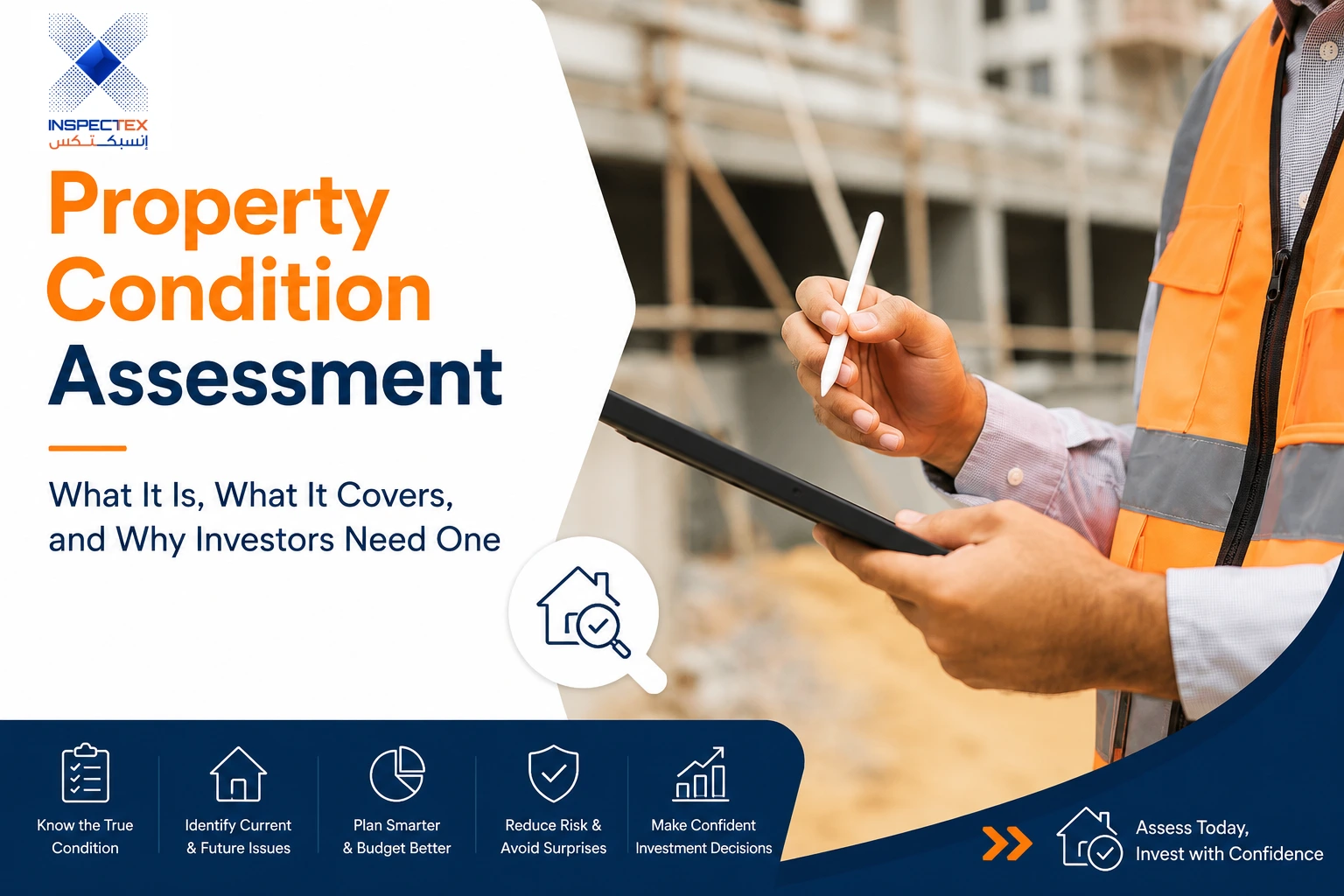
Property Condition Assessment: What It Is, What It Covers, and Why Investors Need One
 Inspectex Team
كل المقالات
2026-06-30
The corporate real estate landscape is undergoing a radical shift, moving away from simple location-based valuations to a profound focus on operational resilience and infrastructure health. Institutional buyers and facility managers now prioritize the exact remaining lifecycle of central cooling plants, the stability of heavy-duty power grids, and strict adherence to environmental regulations. In this data-driven era, Inspectex leads the charge by equipping stakeholders with precise engineering diagnostics right from the start. This guide delves into the mechanics of a property condition assessment, exploring how deep technical analytics directly influence corporate balance sheets and redefine long-term asset management strategies.
What Is a Property Condition Assessment?
Evaluating a commercial facility requires an objective methodology that translates physical building data into actionable financial metrics.
Definition and How It Differs from a Standard Building Inspection
The standard inspection usually applies to smaller residential properties, focusing primarily on immediate functional safety and cosmetic defects for individual buyers. Conversely, this specialized evaluation is a rigorous technical audit tailored specifically for commercial real estate, corporate towers, and industrial facilities. It provides a deep diagnostic of the building’s physical state, focusing heavily on deferred maintenance, system lifecycle analysis, and regulatory compliance. The ultimate goal is to calculate the long-term financial impact of the building’s current state on the investor’s balance sheet.
When Is a PCA Required and Who Typically Commissions One?
Institutional investors, corporate lenders, and real estate investment trusts (REITs) rely heavily on these evaluations before acquiring new assets, refinancing existing portfolios, or negotiating triple-net leases. Requesting a PCA provides these stakeholders with a clear, unbiased understanding of the immediate and short-term capital expenditures required to maintain the facility’s market value. Lenders often make it a mandatory prerequisite for approving commercial mortgages to ensure the collateral is fundamentally sound.
What Does a Property Condition Assessment Cover?
A meticulous evaluation breaks down the massive asset into manageable, specialized engineering categories to ensure no component is overlooked.
Structural, MEP, Roof, and Envelope Systems
The core foundation and operational lifelines of the building undergo strict scrutiny. Civil experts analyze the structural framework for load-bearing stability, settlement cracks, and post-tension slab integrity. They assess the exterior envelope, including facade cladding and roofing membranes, to verify weather resistance and thermal efficiency. Simultaneously, the mechanical, electrical, and plumbing (MEP) networks are evaluated. Engineers test the main electrical switchgear for stability, check the central HVAC chillers for cooling efficiency, and inspect the main plumbing risers to ensure the building operates without excessive energy consumption or fluid leakage.
Interior Finishes, Vertical Transportation, and Life Safety
Beyond the concrete and pipes, the evaluation covers elements that directly impact daily operations and occupant safety. Vertical transportation networks, such as elevators and escalators, are audited for smooth mechanical flow and compliance with maintenance schedules. The internal architectural finishes, including commercial-grade flooring and acoustic partitions, are reviewed for excessive degradation. Crucially, life safety systems like fire alarms, pressurized sprinkler networks, and emergency egress routes are verified to ensure they comply with national safety mandates, protecting the occupants and minimizing the owner’s legal liabilities.
The Property Condition Report: Translating Site Findings into Financial Planning
The true value of the physical field audit is fully realized when the raw engineering data is compiled into a formal property condition report. This extensive document serves as an objective financial ledger, listing immediate repair needs and projecting future replacement costs over a specific timeline.
Using the Findings for Price Negotiation and Capital Budgeting
Equipped with a detailed technical breakdown, buyers gain immense leverage. They can negotiate the final purchase price downward to reflect the exact cost of imminent repairs discovered during the audit. For asset managers taking over an existing property, the document acts as a strategic roadmap. It allows them to allocate accurate annual budgets for replacing aging infrastructure, such as updating an outdated central boiler or replacing a failing roof membrane, rather than facing sudden, uncalculated operational expenses that disrupt cash flow.
PCA vs. BCA vs. FCA: Choosing the Right Assessment
Understanding the specific terminology ensures that corporate investors request the exact diagnostic service required for their unique portfolio.
Building Condition Assessment for Residential and Mixed-Use Properties
A Building Condition Assessment (BCA) is often utilized for large residential complexes, gated communities, or mixed-use developments. It focuses deeply on tenant safety, the degradation of shared materials, and the immediate functionality of communal amenities and utility networks. The primary goal is to ensure the property remains habitable, appealing to tenants, and structurally safe for daily residential use.
Facility Condition Assessment for Industrial and Institutional Assets
In contrast, a Facility Condition Assessment (FCA) is typically reserved for highly specialized environments like hospitals, heavy manufacturing factories, or expansive university campuses. This evaluation incorporates the operational efficiency of specialized industrial or medical equipment alongside the standard architectural and MEP evaluations, providing a holistic view of a highly complex operational facility.
What Defines Credible Property Condition Assessment Companies?
The commercial real estate market is filled with advisory firms, making it critical to partner with an entity that possesses true engineering depth.
Engineering Qualifications, Methodology, and Report Standards
Elite property condition assessment companies stand out through their strict adherence to international and local engineering standards. Reliable firms deploy certified professionals who base their findings on objective metrics, scientific testing, and precise measurements rather than visual approximations. This rigid methodology ensures the final documentation holds undeniable weight and legitimacy in formal boardroom negotiations.
The Multi-Discipline Advantage: Why One Engineer Is Never Enough
Complex commercial assets contain highly intricate, overlapping systems. Relying on a single individual to evaluate post-tensioned concrete, high-voltage electrical panels, and centralized cooling towers is an engineering fallacy. Credible institutions mandate the presence of multiple specialized engineers, each focusing exclusively on their domain of expertise. This collaborative approach prevents any technical oversight and guarantees a thoroughly dissected evaluation of the entire property.
Inspectex: Redefining the Property Condition Assessment Framework
Protecting multi-million-riyal investments requires an uncompromising methodology. Inspectex delivers technical certainty through a highly structured, multi-layered evaluation protocol designed specifically for corporate investors and asset managers.
Strategic Field Operations Exclusively Within Riyadh and Jeddah
To maintain the highest levels of quality control, our physical field operations are strictly limited to the city limits of Riyadh and Jeddah. Our site protocol requires the simultaneous dispatch of three specialized professionals. During the evaluation, a civil engineer assesses the architectural and structural integrity. Concurrently, an electrical engineer conducts deep evaluations of power distribution networks, while a mechanical engineer tests plumbing capacities and HVAC efficiencies. This synchronized approach ensures every system is thoroughly vetted.
Leveraging Non-Destructive Technologies for Subsurface Diagnostics
We integrate cutting-edge non-destructive inspection tools directly into our field routines. By utilizing advanced thermal imaging cameras to detect hidden moisture and overheating circuits, alongside Ground Penetrating Radar (GPR) to map subsurface structural elements, our team extracts vital internal data. These sophisticated instruments allow us to uncover hidden technical realities without causing any physical disruption to the existing architectural finishes.
SBC-Compliant Certified Outputs Tailored for Investors and Asset Managers
Following the site visit, the gathered metrics are immediately transferred to our centralized back-office unit. Here, a dedicated team of 7 specialized engineers processes the findings, ensuring every observation is cross-referenced with the Saudi Building Code (SBC). Within a strict window of 3 to 7 working days, the final document is compiled, featuring an accurate Bill of Quantities (BOQ) with live market repair estimates. Once approved by our Senior Technical Manager, this definitive inspection report gains official legitimacy, supported by our corporate accreditations from the Saudi Standards, Metrology and Quality Organization (SASO) and the Saudi Accreditation Center (SAAC). Furthermore, to support your long-term risk assessment strategies, all technical records are securely archived in our databases for 10 consecutive years.
Frequently Asked Questions
What Is a Property Condition Assessment?
It is a detailed engineering evaluation conducted on commercial real estate to identify physical deficiencies, code violations, and deferred maintenance, ultimately projecting future capital expenditures to help investors make informed decisions.
What Is Included in the Final Deliverables?
The final document includes a comprehensive breakdown of the civil and MEP systems, supported by photographic evidence, risk prioritization, and a precise financial estimate for necessary repairs or component replacements.
How Do I Find Reliable Property Condition Assessment Companies?
Seek out firms that deploy multi-disciplinary teams of specialized engineers, utilize non-destructive diagnostic tools, and provide legally backed reports compliant with national building codes, ensuring absolute technical accuracy.
Solidify Your Next Commercial Acquisition with Certified Intelligence
Navigating the complexities of commercial real estate requires moving beyond traditional valuation models and embracing deep technical intelligence. The true profitability of a corporate facility is inextricably linked to the hidden health of its mechanical and structural frameworks. Integrating a comprehensive diagnostic strategy allows asset managers to proactively shape their maintenance budgets, maximize long-term yields, and eliminate uncalculated operational disruptions. By partnering with Inspectex, you gain access to an elite engineering perspective that transforms technical uncertainties into calculated, actionable business data. Contact our experts today to schedule your commercial property inspection and ensure your portfolio remains robust and highly competitive in a demanding market.
