Electrical Problems in the House: Your Guide to Detection, Prevention, and Safe Solutions
 Inspectex Team
كل المقالات
2026-04-03
The operational efficiency of modern residential facilities relies entirely on the continuous and stable flow of electrical energy. In today’s highly demanding environment, operational requirements have shifted drastically from basic lighting to powering complex HVAC systems, electric vehicle chargers, and high-load smart home networks. This significant shift in consumption patterns has transformed electrical problems in the house into a complex engineering challenge that requires continuous, specialized technical oversight.
At Inspectex, we treat your residential electrical system as critical infrastructure governed strictly by the Saudi Building Code (SBC). Any flaw in the initial design or execution poses a direct threat to the building’s sustainability and long-term investment value. This comprehensive guide serves as a deeply technical reference for property owners and investors. It highlights the concealed structural flaws that non-specialists often overlook and provides a clear, data-driven methodology for handling electrical issues in the home.
Our primary goal at Inspectex is to elevate property evaluation from a routine visual check into a strategic asset management tool. By relying on undeniable technical facts rather than the guesswork of unqualified labor, we ensure maximum operational efficiency and ultimate safety for your property.
What Are the Most Common Electrical Problems in Houses?
The majority of technical challenges within an electrical network stem from a structural mismatch between the circuit’s original design capacity and the actual physical loads applied by the occupants. Understanding the root causes of electrical problems in the house requires precise monitoring of breaker mechanisms, copper conductors, and their endurance under high-stress operational conditions.
Overloaded Circuits and Power Imbalance
One of the most frequent technical deviations is phase load imbalance across a 3-phase system. This occurs when high-consumption appliances are poorly distributed. The engineering impacts include:
- Phase Overloading: Connecting an excessive number of heavy appliances (like AC units and heaters) to a single phase rather than distributing them evenly across the network.
- Thermal Stress: The immediate result is a severe temperature spike in the main feeder cable, compromising its internal insulation.
- System Shutdowns: Repeated tripping of the main breaker occurs as the system attempts to protect itself from critically exceeded capacity limits.
Faulty Wiring and Voltage Fluctuations
Another critical structural failure is the loss of the neutral line or the use of improper wire gauges. This specific defect causes dangerous voltage fluctuations across the entire network:
- Irregular Frequencies: Power surges and drops that create an unstable electrical environment.
- Equipment Destruction: This instability can lead to the instantaneous destruction of sensitive electronic boards in modern appliances and smart home systems connected to the affected circuits.
- Prevention Strategy: Identifying these electrical issues in-house early is paramount to preventing mass equipment failure and costly replacements.
Ground Connection Issues and Arc Fault Risks
Corrosion or loosening at connection points inside the main distribution panels is the primary catalyst for the electrical arcing phenomenon:
- High Resistance Junctions: Loose connections force the electrical current to jump or arc across microscopic gaps.
- Extreme Heat Generation: This arcing generates intense, localized heat that rapidly melts surrounding plastic insulation.
- Thermal Fires: Arc faults remain responsible for the vast majority of electrical thermal fires in residential buildings, acting as a hidden, immediate fire hazard.
Aging Electrical Systems and Fire Hazards
We cannot overlook the degradation of insulation resistance in buried or wall-embedded wiring. This decay happens gradually and presents severe threats:
- Material Drying: Plastic insulators dry out and crack due to prolonged exposure to thermal stress or environmental humidity.
- Current Leakage: As the insulation fails, electrical current leaks into surrounding metal frames, plumbing fixtures, or concrete walls.
- Lethal Consequences: This not only causes severe electrical problems in the house by heavily inflating energy consumption but also creates a lethal shock hazard upon physical human contact.
How Electrical Inspection Helps You Avoid These Risks
An independent engineering audit serves as the true safety valve for any residential facility. Modern diagnostic technologies allow specialized engineers to monitor latent defects before they escalate into total system failures or life-threatening accidents. Addressing electrical problems in the house proactively ensures that all components remain strictly within the safe operating thresholds defined by national engineering standards.
Insulation Resistance Testing and Current Leakage Detection
A specialized electrical engineer utilizes advanced diagnostic protocols to secure the hidden wiring infrastructure:
- Megohmmeter Diagnostics: Deploying advanced megohmmeters to precisely measure the insulation resistance of wires routed safely inside conduits and walls.
- Zero Leakage Verification: This crucial test guarantees there is absolutely zero current leakage within the structural envelope.
- Financial Protection: Preventing current escape directly eliminates unjustified energy waste that typically manifests as inexplicably high monthly utility bills.
Earthing System Verification and GFCI Testing
A comprehensive audit must include rigorous testing of the property’s grounding system to ensure maximum occupant protection:
- Electrode Resistance Measurement: Specialized engineers measure the exact resistance of the earth electrode to ensure it can immediately dissipate excess electrical surges directly into the ground.
- GFCI Verification: The engineering team rigorously tests Ground Fault Circuit Interrupters (GFCI) to verify they provide instantaneous shock protection.
- Wet Zone Safety: Addressing these specific electrical issues in the home is completely non-negotiable for ensuring occupant safety in high-moisture areas such as kitchens and bathrooms.
Identifying Fault Points Using Thermal and Load Analysis
Our engineering teams deploy high-resolution thermal imaging cameras to map out the system without unnecessary demolition:
- Non-Destructive Testing (NDT): Scanning distribution panels and wall switches to identify hidden thermal stress and overloaded wires behind closed doors.
- Root-Cause Pinpointing: By analyzing the exact thermal signatures and load distributions, our engineers can pinpoint the exact root causes of electrical problems in the house rather than merely addressing the superficial symptoms.
Electrical Problem Solutions with Inspectex
Inspectex provides an integrated, technology-driven framework designed to correct all technical deviations in a building’s electrical system based on highly accurate field data. We firmly believe that resolving electrical problems in the house must begin with an accurate diagnosis of the root causes to guarantee the longevity of the solutions and prevent the recurrence of faults.
During our comprehensive audits, our multi-disciplinary team, consisting of a Civil/Architectural Engineer, an Electrical Engineer, and a Mechanical Engineer, applies strict non-destructive testing methodologies. This specialized team verifies wire gauges against operational loads and ensures all breakers comply perfectly with the Saudi Building Code (SBC).
Comprehensive Inspection and Detailed Technical Reports
Following the field audit, the collected data undergoes rigorous office-based analysis. The report is not simply written and reviewed by the field engineers; instead, it passes through multiple stages of rigorous auditing involving an inspection team, an analysis team, a recommendations team, and final approval by a technical manager.
Within 3 to 7 working days, the client receives a comprehensive PDF report. This detailed PDF document classifies defects based on technical severity, provides clear thermal and photographic evidence, and issues binding engineering recommendations. Furthermore, to guarantee the highest safety and quality standards, Inspectex holds the rigorous accreditation of the Saudi Standards, Metrology, and Quality Organization (SASO). This ensures property owners possess the undeniable technical facts needed to negotiate repairs professionally.
When Should You Inspect the Electrical System in Your Home?
The necessity for specialized engineering oversight is not limited strictly to emergency breakdowns. It is a strategic, preventive measure that must be executed at specific lifecycle stages to maintain residential safety and preserve the property’s financial value against severe electrical issues in the house.
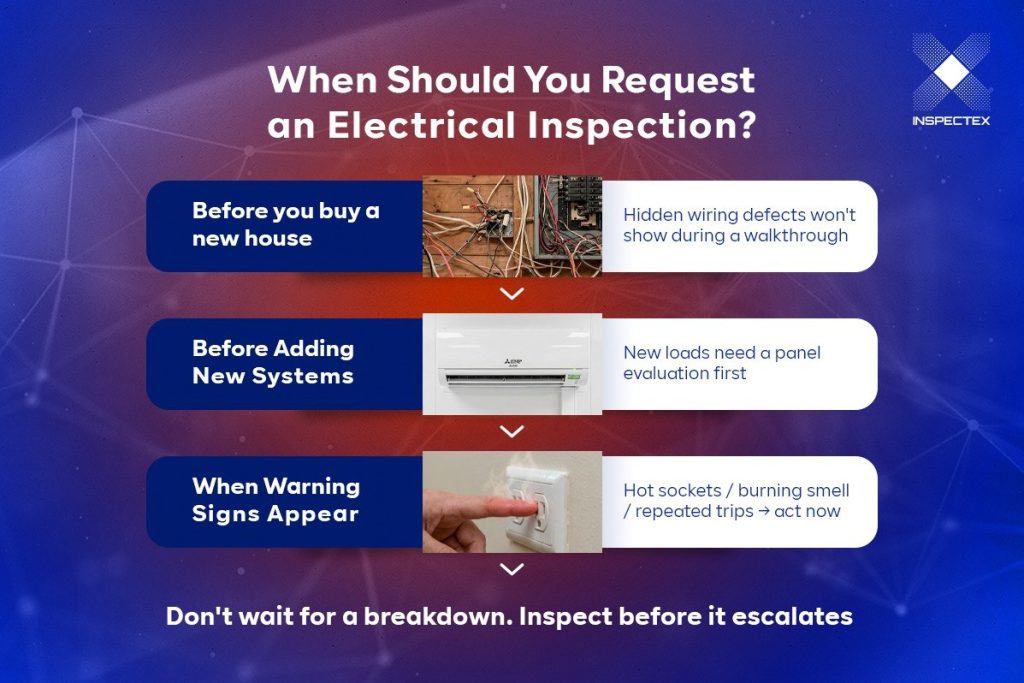
Before Purchase or When Installing New Systems
The pre-purchase phase is the most critical juncture for an engineering audit:
- Uncovering Hidden Flaws: A specialized engineer will uncover concealed electrical defects that a buyer cannot see during a standard visual walkthrough, such as deteriorated wiring insulation.
- Distribution Panel Evaluation: Assessing poor foundational setups or improper wire sizing in the main distribution panels before finalizing the purchase.
- Warning Sign Intervention: Immediate assessment is required when observing clear warning signs, such as unusually hot wall sockets, the smell of burning plastic, or repeated breaker tripping. Ignoring these warning signs will rapidly escalate electrical problems in the house, transforming minor faults into severe thermal hazards.
Inspectex’s Electrical Inspection Process
Inspectex relies on a highly systematic field methodology that begins with dispatching a specialized engineering team to review the electrical systems against the original design schematics.
Room-by-Room Panel-to-Point Electrical Assessment
Our engineering approach covers every single point of power transfer:
- Systematic Coverage: Our engineers cover every component of the network, starting from the main utility distribution panels down to the furthest sub-sockets.
- Precision Measurement: Utilizing state-of-the-art measuring devices, we guarantee the precision of the installation and the absolute safety of the wiring infrastructure.
- Data Certification: In the final stage, all field data is thoroughly analyzed to issue the integrated engineering reports that certify the system’s operational safety. This exhaustive process is the ultimate defense against recurring electrical problems in the house.
Impact of Electrical Problems on Modern Homes
Proactive technical intervention to correct electrical faults yields tangible, immediate benefits for the property owner on both technical and financial levels.
Smart Systems, Power Surges, Risks, and Sensitive Appliances
- Voltage Stability: Early detection ensures the stability of the voltage reaching your appliances, acting as the primary defense for complex electronic boards.
- Asset Protection: It protects smart home systems and modern air conditioning units from premature degradation or sudden combustion caused by irregular electrical frequencies.
- Lifespan Extension: Managing electrical issues in-house directly extends the operational lifespan of your high-value assets.
High Electricity Consumption and Inefficient Systems
- Energy Optimization: Proactive assessment significantly reduces the energy loss caused by utilizing worn-out wires or cables with inadequate copper cross-sections.
- Cost Reduction: This structural optimization directly and positively impacts the reduction of your monthly utility consumption bills.
- Absolute Safety: Most importantly, resolving electrical issues in the home provides absolute safety for occupants against the risks of electrocution in wet zones and protects the entire structural envelope from electrical fires initiated by neglected loose connections.
FAQs: Electrical Problems in the Home
What Are Common Electrical Problems in Houses?
The most prevalent structural faults include phase load imbalances, deteriorated wire insulation, absent grounding systems, and loose panel connections that cause dangerous electrical arcing.
How Do I Know If There Is an Electrical Problem in My Home?
Critical technical indicators include unusually hot wall sockets, buzzing sounds from the breaker panel, or a burning plastic odor. These signs require immediate engineering intervention.
Can Electrical Problems Cause Damage to Appliances?
Absolutely. Sudden voltage fluctuations, loss of the neutral line, or persistent micro-surges can instantly fry the sensitive microprocessors and electronic boards inside smart TVs, modern refrigerators, and HVAC systems, leading to total and irreversible equipment failure.
Book an Electrical Inspection for Your Home with Inspectex
Safety inside your residence is the direct result of sound engineering decisions based on factual field data and modern measurement technologies, not a matter of luck or random technical estimation. At Inspectex, we provide the technical precision and engineering reliability required to guarantee that your electrical system operates at peak efficiency while strictly adhering to the global safety standards mandated by the Saudi Building Code (SBC).
Do not leave the structural integrity of your home to individual guesswork or unqualified labor that may exacerbate the fault rather than providing a definitive root-cause solution. Rely on a systematic engineering audit that analyzes, measures, and delivers the correct technical recommendations to protect your real estate investment.
Address your electrical problems in the house decisively. Contact Inspectex today to schedule your comprehensive field assessment, available exclusively in Riyadh and Jeddah, and secure sustainable safety and long-term value for your property through our specialized engineering teams.
